

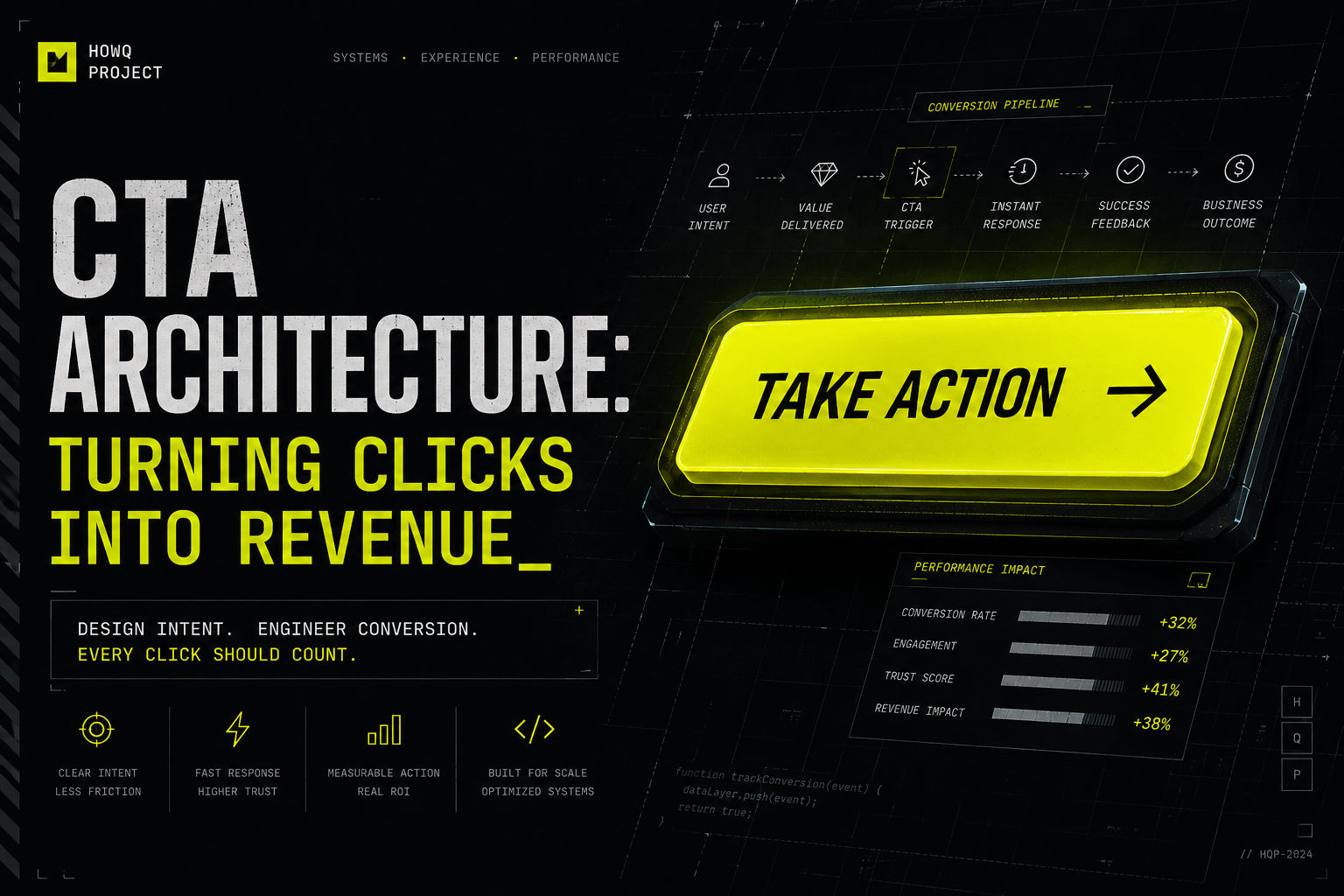
Every CTA Is a Performance Decision
A Call-to-Action is not a button. It is a conversion endpoint that connects user intent with measurable business outcomes. Every additional interaction, delayed response, or unclear message increases friction and reduces the probability of conversion.
Organizations often invest thousands of dollars into design systems, infrastructure, and content while treating the CTA as a visual component instead of a system architecture problem. The result is predictable: high traffic, low conversion.
CTA latency is rarely discussed, yet it directly affects user confidence. When action feels immediate, trust increases. When interaction feels uncertain, abandonment follows.
The highest-converting CTA is rarely the most creative one. It is the one that minimizes cognitive load while maximizing user confidence.
CTA Is Part of the Conversion Pipeline
A modern CTA should be designed as part of an end-to-end conversion architecture instead of an isolated UI element.
The execution path typically looks like this:
- User intent is established.
- Content reduces uncertainty.
- CTA confirms the expected outcome.
- Backend processes the request instantly.
- Success feedback reinforces trust.
- Analytics capture the entire interaction.
Every layer contributes to conversion efficiency.
If one component introduces delay, ambiguity, or inconsistency, the entire pipeline loses effectiveness.
Why Beautiful Buttons Fail
Many interfaces prioritize aesthetics over decision architecture.
Common problems include:
- Generic copy such as "Learn More."
- Multiple competing CTAs on the same viewport.
- Weak visual hierarchy.
- Slow API response after clicking.
- Hidden pricing or unclear expectations.
- Mobile layouts that bury the primary action.
These issues create decision fatigue instead of guiding users toward commitment.
Effective CTA Copy Prioritizes Outcomes
Users do not click because a button looks attractive.
They click because the value proposition is immediately obvious.
Compare the difference:
| Generic CTA | Outcome-Oriented CTA |
|---|---|
| Learn More | See the Architecture Demo |
| Contact Us | Schedule a Technical Consultation |
| Get Started | Launch Your First Deployment |
| Submit | Generate Performance Report |
| Buy Now | Start Scaling Today |
Outcome-focused language reduces uncertainty and aligns with user intent.
Performance Is Part of CTA Design
A CTA cannot compensate for poor application performance.
Key engineering considerations include:
- Minimize JavaScript execution before interaction.
- Reduce First Input Delay (FID) and Interaction to Next Paint (INP).
- Preload critical assets.
- Avoid layout shifts near primary buttons.
- Optimize server response time.
- Cache predictable requests.
- Compress payloads.
- Eliminate unnecessary redirects.
Every millisecond removed from the interaction path increases the probability of successful completion.
The Business Cost of CTA Friction
Small interaction delays accumulate into measurable revenue loss.
| Architecture Decision | Business Impact |
|---|---|
| Fast page rendering | Higher engagement |
| Clear CTA hierarchy | Better conversion rate |
| Instant feedback | Increased trust |
| Consistent messaging | Lower bounce rate |
| Optimized mobile layout | Higher lead generation |
| Event tracking | Accurate ROI measurement |
High-performing organizations measure CTA performance with business metrics rather than visual preferences.
CTA Placement Is a System Decision
Positioning should follow user readiness instead of arbitrary design conventions.
Effective placement strategies include:
- Above the fold for high-intent landing pages.
- After presenting measurable business value.
- Immediately following pricing clarification.
- At the end of technical documentation.
- Following customer proof or case studies.
- Repeated naturally throughout long-form content without overwhelming the interface.
Visibility should support momentum rather than interrupt reading flow.
Measure Architecture, Not Assumptions
Every CTA should produce observable data.
Track metrics such as:
- Click-through rate (CTR)
- Conversion rate
- Scroll depth before interaction
- Session completion
- Form abandonment
- Time to conversion
- Revenue per visitor
- Customer acquisition cost (CAC)
Without instrumentation, optimization becomes opinion instead of engineering.
Build CTAs Like Infrastructure
Elite digital products treat every CTA as an engineered system with defined inputs, measurable outputs, and continuous optimization. Design attracts attention, but architecture determines whether attention becomes revenue. The next competitive advantage won't come from another brighter button—it will come from faster systems, clearer intent, and conversion paths engineered with the same precision as the platform behind them.